reference — getting there
Domain name system
in short — written for this site
Translates a domain name to an IP address — a hierarchical, heavily cached lookup before any request is made.
record types
NS points at a name server for the domain. MX at a mail server. A maps a name to an IPv4 address, AAAA to IPv6. CNAME points one name at another name or at an A record.
routing
Weighted round robin can prevent traffic going to servers under maintenance and balance across cluster sizes. Latency-based routing sends the client to the nearest region. Geolocation-based routing decides by the origin of the request.
cost
Accessing a DNS server introduces a slight delay, and DNS server management is complex and generally managed by governments, ISPs and large companies. DNS services have recently come under DDoS attack.
from the primer — full sectionsynced
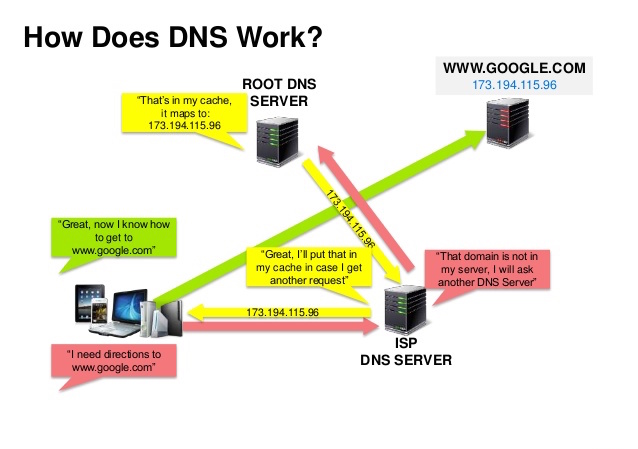
A Domain Name System (DNS) translates a domain name such as www.example.com to an IP address.
DNS is hierarchical, with a few authoritative servers at the top level. Your router or ISP provides information about which DNS server(s) to contact when doing a lookup. Lower level DNS servers cache mappings, which could become stale due to DNS propagation delays. DNS results can also be cached by your browser or OS for a certain period of time, determined by the time to live (TTL).
- NS record (name server) - Specifies the DNS servers for your domain/subdomain.
- MX record (mail exchange) - Specifies the mail servers for accepting messages.
- A record (address) - Points a name to an IP address.
- CNAME (canonical) - Points a name to another name or
CNAME(example.com to www.example.com) or to anArecord.
Services such as CloudFlare and Route 53 provide managed DNS services. Some DNS services can route traffic through various methods:
- Weighted round robin
- Prevent traffic from going to servers under maintenance
- Balance between varying cluster sizes
- A/B testing
- Latency-based
- Geolocation-based
Disadvantage(s): DNS
- Accessing a DNS server introduces a slight delay, although mitigated by caching described above.
- DNS server management could be complex and is generally managed by governments, ISPs, and large companies.
- DNS services have recently come under DDoS attack, preventing users from accessing websites such as Twitter without knowing Twitter's IP address(es).
Source(s) and further reading
sourcedonnemartin/system-design-primer / README.mdanchor#domain-name-systemsyncedsynced from donnemartin/system-design-primer@master · 2026-08-17